The Five-Minute Ritual Trap
The five-minute ritual trap turns a useful pause into another task. Make a small cue flexible enough to survive ordinary days, interruptions and changing needs.
The five-minute ritual trap begins when a small pause acquires rules: it must happen at the same time, in the same order, for the same length of time. A ritual does not need that much administration. Its meaning can come from a small, adaptable cue that helps you notice a transition or return to an intention.
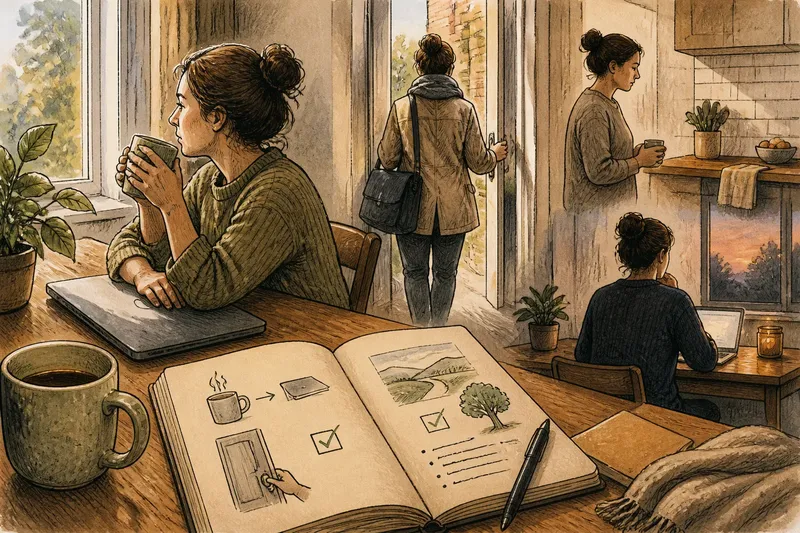
Five minutes is a convenient measure, not a standard of sincerity. A cup of tea before opening your laptop, a hand on the door handle before leaving home, or a brief look out of the window can all mark a moment. The useful question is not whether you completed the full routine. It is whether the cue still helps you meet the moment you meant to mark.
A ritual becomes a task when its rules multiply
An elaborate routine can feel reassuring at first. Then a missed item starts to seem like failure. You may decide that the candle, notebook, quiet room and carefully chosen playlist are all necessary, even though the original purpose was simply to pause before the day began.
This usually happens when the visible form takes over from the reason for doing it. Try naming that reason in plain language: “I want to arrive before I start answering messages,” or “I want to mark the end of work.” Keep one cue that serves that purpose and let the accessories remain optional.
Say you begin each workday by lighting a candle, writing three lines and sitting without your phone. On a rushed morning, the whole sequence feels unavailable, so you skip it. If the actual purpose is to pause before work, you could instead take one breath with your hand on the closed laptop. The expected observable result is a recognisable pause, not a perfect imitation of the longer routine.
What is not worth the effort is buying special objects to make an ordinary cue feel official. A distinctive mug or notebook may be pleasant, but the ritual should not depend on a shopping list.
The cue disappears when the day changes
A ritual tied to a precise time or place can be fragile. A late train, a noisy kitchen or a shift in your schedule may remove the conditions you assumed were essential. The cause is often not weak discipline; it is a cue with only one doorway into the day.
Choose a portable signal instead. You might use the first sip of a drink, the moment you close a work document, or the act of putting your keys down. Attach the ritual to something that already happens, then decide what the smallest version looks like when the usual setting is missing.
For instance, imagine you use a quiet moment at the kitchen table to acknowledge the end of the workday. If you are away from home, you could close your laptop and name one thing you are leaving for tomorrow. The action changes, while the transition remains legible. A cue that travels is often more useful than a setting that must be protected.
Repetition starts to feel empty
Doing the same action repeatedly does not automatically keep it meaningful. A familiar phrase can become background noise, especially if you say it while mentally rushing on to the next task. The problem may be that the cue no longer asks for attention, not that the ritual needs more steps.
Keep the action, but refresh the thing you notice. During a short walk, attend to the temperature or the sound of your shoes. Before dinner, pause to register who is present, even if the meal is ordinary. The ritual stays small; your attention supplies the variation.
It can also help to change the cue when its original purpose has passed. A bedtime reading ritual may have helped create a boundary around work, but a different evening pattern may suit a new schedule. Adaptation is not evidence that the earlier practice failed. It is a way of keeping the action connected to current life rather than preserving it as a relic.
Missing a day turns into a reason to quit
Some people treat a skipped ritual as a broken chain. That makes the next attempt carry unnecessary weight: it must repair the past as well as serve the present. The usual cause is an all-or-nothing definition of consistency, where only an identical performance counts.
Replace the chain with a return point. Decide on a version that is easy to resume, and let a missed occasion remain missed. If you normally write a few lines at night, the return point might be opening the notebook and recording one detail from the day. There is no need to recreate the previous evening or make up for it.
This does not mean every ritual must be reduced until it is effortless. It means the practice should have a sensible range. A longer version can be welcome when time and attention are available; a brief version can preserve the cue when they are not. Neither needs to be treated as the authentic one.
How can a small ritual stay useful?
How do I know whether a ritual is too elaborate?
Notice whether missing one part makes you abandon the whole practice or feel that you have done it incorrectly. If so, identify the purpose and keep the simplest action that still signals it.
Does a ritual need to happen every day?
No. A cue can mark a recurring kind of moment without appearing daily. Choose a rhythm that fits the moment you want to recognise, rather than treating frequency as proof of meaning.
What if I forget the ritual altogether?
Attach it to an existing action, such as closing a notebook or putting a mug in the sink. If you forget, resume the next time the cue is available; a missed occasion does not need a formal correction.
Can the ritual change over time?
Yes. Keep the purpose under review and let the action shift as your circumstances do. If the cue no longer helps you notice or mark anything, it can be altered or set aside.
Let the cue carry the meaning
The five-minute ritual trap is not really about the clock. It is the assumption that a meaningful practice must be protected from interruption, repetition or change. A small cue can be enough when it makes a moment easier to notice: the first sip before messages, the closed laptop after work, or a brief pause at the front door.
Try one cue for the transition you actually face, and give it a short form for busy days. If it becomes another obligation, simplify it; if its purpose changes, change the cue. The most useful ritual is not the one you can perform perfectly, but the one that still belongs to the life you are living.