Why Objects Become Keepsakes
Why objects become keepsakes: see how use, memory and inheritance turn ordinary possessions into personal records, and decide what deserves keeping.
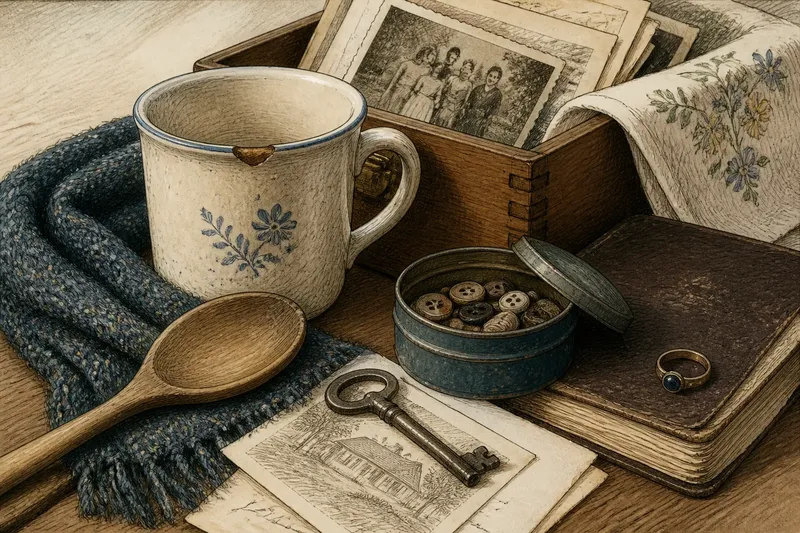
Why objects become keepsakes is less a question of what they are made of than of what has happened around them. A chipped mug can carry more meaning than a valuable ornament because it was there for breakfast, late conversations and the ordinary days that later acquire a name.
That transformation is gradual. The object begins as something useful, decorative or simply available. Repeated use gives it a place in someone’s life; a particular event may make that place vivid; and later, a handover can add another person’s history. Meaning gathers in layers, often without anyone deciding to create a keepsake.
Use gives an ordinary object a place in daily life
Familiar possessions become noticeable through repetition. A wooden spoon turns up beside the same saucepan. A coat is reached for on the same walk. A small tin holds the buttons needed for mending. These objects participate in routines, and their meaning may start as the quiet familiarity of knowing where they are and how they work.
That familiarity is not the same as sentiment. A useful object can remain merely useful for years. Still, use supplies a history: a handle grows smooth, a notebook fills, a leather wallet softens at its folds. Wear marks are not proof of emotional importance, but they make time visible. The object carries traces of contact that a new replacement cannot yet have.
Use also ties an object to a role. A particular apron may belong to the person who cooks for the family; a set of gardening shears may recall someone who kept a shared patch of ground in order. The object is not a complete record of that person. It is a small, tangible link to activities others remember them doing.
Memory changes what the object can stand for
A possession often becomes a keepsake when an event gives it a second meaning. A plain ticket stub can recall a day spent travelling with a friend. A repaired chair may bring to mind the person who taught its owner to mend things. The event need not be dramatic. A recurring, modest scene can matter because it belongs to a relationship or period that is no longer present in quite the same way.
Memory is selective, so an object rarely preserves a whole scene. It acts more like a prompt: the smell of a wool scarf, the weight of a key, the uneven rim of a bowl can bring back details that no written description would have supplied. Other details may be forgotten or altered. A keepsake is therefore a personal record, not an impartial archive.
Its meaning may also change over time. A child’s drawing might first be saved because it was charming, then kept as evidence of a particular age, and later become one of the few things left from a home that has changed. The paper has not changed much; the owner’s position in relation to it has.
How do objects become keepsakes?
Does an object need to be old to matter?
No. Age can make wear and continuity easier to see, but a recent object may already be tied to a person, place or event. Meaning depends on the history someone associates with it, not on how long it has been in a drawer.
Can a useful object be a keepsake?
Yes. Daily use can be part of what makes a possession meaningful, especially when it recalls a familiar task or a person’s habits. Some owners keep using such objects; others prefer to protect them from further wear.
Why do people keep things other people would discard?
People attach different memories to the same material thing, and some memories are known only to the person who lived them. A broken ornament may be clutter to one person and a reminder of a shared household to another. Neither judgement tells the whole story.
Does keeping a keepsake require keeping the original?
Not always. A photograph, a written account or an object that carries the same association may be enough for some people. For others, the material itself matters because its texture, marks or presence are part of the memory.
Inheritance adds another person’s history
When an object passes between people, its earlier life arrives with it, though often in fragments. A relative may hand down a recipe book with notes in the margins, a ring, a work tool or a table with a repaired corner. The recipient receives both the object and whatever account accompanies it: who used it, where it came from, or why it was kept.
That account can make the object more legible, but it does not settle its meaning. A descendant may value the story, feel little connection to it, or find that the object acquires a different association through their own use. Inheritance is not a command to feel the same way as the previous owner. It is an invitation to decide what, if anything, to carry forward.
Stories can also become thinner as they pass on. Names are forgotten, details blur, and an object may outlast the person who could explain it. A short note in a box or on the back of a photograph can preserve what is known without dressing uncertainty up as fact. “Used in the family kitchen; owner unknown” is more useful than an invented certainty.
Meaning can be shared, private or contested
Some keepsakes belong to a shared story: a bowl used at family meals, a banner kept by a group, or a book passed among friends. Others matter to one person for a reason no one else knows. Private meaning does not need to be made persuasive before it counts, though it can help to explain it when other people must decide what happens to the object.
Shared possessions can become difficult when different people claim different histories. One sibling may remember a clock as a gift from a grandparent; another may remember the grandparent’s daily habit of winding it. The object can hold both associations. If it must be divided or moved, a calm account of what each person values is more helpful than pretending there is a single correct emotional owner.
Not every inherited possession needs to become a keepsake. A box of papers can include objects with no known story, and a person may feel affection for a relative without wanting their furniture. Letting an item go need not erase the relationship. Keeping everything, meanwhile, can make the meaningful pieces harder to notice. That is the part of remembrance that is not worth the effort: treating storage as a measure of loyalty.
Keeping the story does not always mean keeping the object
A useful question is what part of the connection matters most. It may be the object’s daily function, its physical marks, the story attached to it, or the fact that a particular person chose it. If the object is fragile, awkward to use or difficult to house, another way of preserving that connection may suit better.
Say you inherit a chipped blue bowl that your aunt used for mixing dough. You have no room to store it safely and would not use it in the kitchen. You could ask a relative who remembers her cooking whether they want it, write down what you know about its use, and photograph the crack beside the note. The expected result is a record that keeps the bowl’s known story available, whether or not the bowl stays with you. The choice may still feel imperfect; practical decisions often do not arrive with a ceremonial finish.
Other options include keeping a small part of a larger object, displaying a possession where it can be encountered, or passing it to someone who will use it. A photograph can preserve shape and detail, while a few sentences can preserve context that an image cannot show. Neither replacement is identical to the original, and they need not pretend to be.
Choosing what to preserve
When deciding about a possession, consider a few concrete questions:
- What do I know about its history? Separate remembered details from guesses, and record uncertainty plainly.
- Does its meaning come from use, a person or a particular event? Naming the source can clarify what you want to preserve.
- Would I rather use it, display it or protect it? The answer may point to a place for it or show that it is time to pass it on.
- Does someone else have a closer connection? Ask without assuming that age, ownership or family position settles the question.
- Could a note or photograph carry enough of the story? Decide what the physical object adds that a record cannot.
These questions are not a test of whether an attachment is valid. They help distinguish the object itself from the story wrapped around it, so a person can make a choice with fewer unspoken assumptions. A keepsake can be kept, shared, used until it wears out, or released with its story intact.
Objects become keepsakes through attention accumulated over time: use, remembered scenes and the accounts people pass along. The meaning may remain private, shift with a new owner or fade as details are lost. When a possession matters, a brief note about who used it and why can help its story travel; when it does not, no elaborate explanation is required.